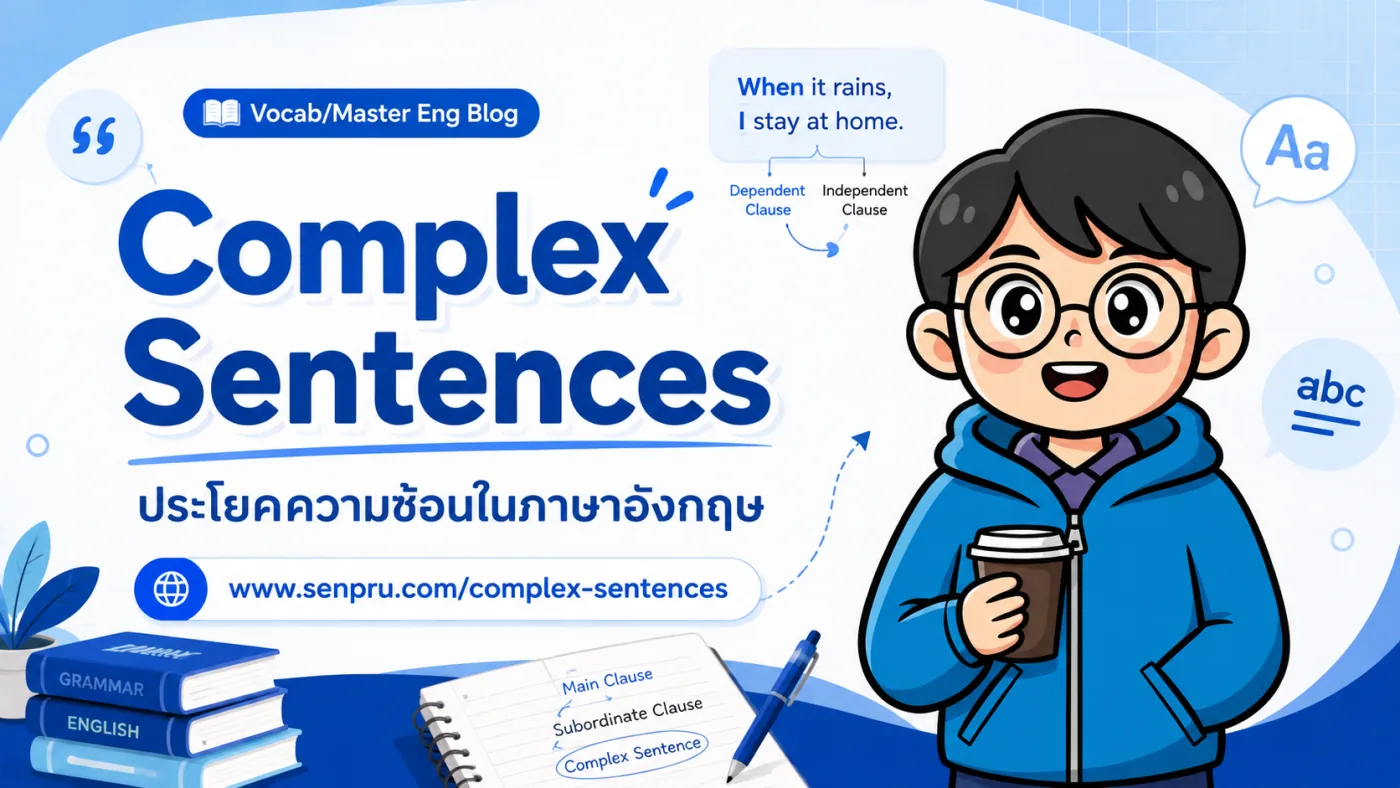
- Complex Sentences: ประโยคความซ้อนในภาษาอังกฤษ
- 1. Complex Sentence คืออะไร?
- 2. โครงสร้างพื้นฐานของ Complex Sentences
- 3. Subordinating Conjunctions ที่ใช้บ่อย
- 4. Dependent Clauses ที่สำคัญ
- 5. การใช้เครื่องหมายจุลภาค
- 6. Complex Sentence กับ Compound Sentence ต่างกันอย่างไร?
- 7. ตัวอย่าง Complex Sentences ตามสถานการณ์
- 8. ข้อผิดพลาดที่พบบ่อย
- 9. เทคนิคสร้าง Complex Sentences
- 10. แบบฝึกหัด
- 11. เฉลย
- 12. สรุป
#Complex Sentences: ประโยคความซ้อนในภาษาอังกฤษ
Complex Sentence หรือ ประโยคความซ้อน เป็นประโยคที่ประกอบด้วยประโยคหลักอย่างน้อย 1 ประโยค และอนุประโยคอย่างน้อย 1 อนุประโยค การใช้ประโยคชนิดนี้ช่วยให้เราสื่อสารความสัมพันธ์ของเหตุการณ์ได้ชัดเจนขึ้น เช่น เหตุผล เวลา เงื่อนไข ความขัดแย้ง และวัตถุประสงค์
#1. Complex Sentence คืออะไร?
Complex Sentence ประกอบด้วยองค์ประกอบสำคัญ 2 ส่วน ได้แก่
- Independent Clause — ประโยคหลักที่มีความหมายสมบูรณ์และอยู่ได้ด้วยตัวเอง
- Dependent Clause — อนุประโยคที่มีประธานและกริยา แต่ไม่สามารถอยู่เป็นประโยคสมบูรณ์ได้
#ตัวอย่าง
I stayed home because it was raining.
I stayed home= Independent Clausebecause it was raining= Dependent Clause
ความหมาย: ฉันอยู่บ้านเพราะฝนกำลังตก
#2. โครงสร้างพื้นฐานของ Complex Sentences
Complex Sentences สามารถเขียนได้ 2 รูปแบบหลัก
#รูปแบบที่ 1: Independent Clause + Dependent Clause
Independent Clause + Subordinating Conjunction + Dependent Clause
ตัวอย่าง:
She went to bed early because she was tired.
เธอเข้านอนเร็วเพราะเธอเหนื่อย
เมื่อประโยคหลักอยู่ก่อน โดยทั่วไปไม่ต้องใส่เครื่องหมายจุลภาค
#รูปแบบที่ 2: Dependent Clause + Independent Clause
Subordinating Conjunction + Dependent Clause, + Independent Clause
ตัวอย่าง:
Because she was tired, she went to bed early.
เพราะเธอเหนื่อย เธอจึงเข้านอนเร็ว
เมื่ออนุประโยคอยู่ก่อน ต้องใส่เครื่องหมายจุลภาคคั่นระหว่างสองส่วน
#3. Subordinating Conjunctions ที่ใช้บ่อย
Subordinating Conjunction คือคำเชื่อมที่ทำให้ประโยคหนึ่งกลายเป็น Dependent Clause
#3.1 แสดงเหตุผล
| คำเชื่อม | ความหมาย |
|---|---|
| because | เพราะว่า |
| since | เนื่องจาก |
| as | เพราะว่า / เนื่องจาก |
ตัวอย่าง:
We canceled the trip because the weather was bad.
เรายกเลิกการเดินทางเพราะสภาพอากาศไม่ดี
#3.2 แสดงเวลา
| คำเชื่อม | ความหมาย |
|---|---|
| when | เมื่อ |
| while | ขณะที่ |
| before | ก่อนที่ |
| after | หลังจากที่ |
| until | จนกระทั่ง |
| as soon as | ทันทีที่ |
ตัวอย่าง:
When the class ended, the students left the room.
เมื่อชั้นเรียนจบลง นักเรียนก็ออกจากห้อง
#3.3 แสดงเงื่อนไข
| คำเชื่อม | ความหมาย |
|---|---|
| if | ถ้า |
| unless | ถ้าไม่ / เว้นแต่ |
| provided that | โดยมีเงื่อนไขว่า |
| as long as | ตราบใดที่ |
ตัวอย่าง:
You can pass the exam if you study regularly.
คุณสามารถสอบผ่านได้ถ้าคุณอ่านหนังสืออย่างสม่ำเสมอ
#3.4 แสดงความขัดแย้ง
| คำเชื่อม | ความหมาย |
|---|---|
| although | แม้ว่า |
| though | แม้ว่า |
| even though | ถึงแม้ว่า |
| whereas | ในขณะที่ / แต่ในทางตรงกันข้าม |
| while | ในขณะที่ |
ตัวอย่าง:
Although the task was difficult, she completed it on time.
แม้ว่างานจะยาก แต่เธอก็ทำเสร็จตรงเวลา
ข้อควรระวัง: ไม่ใช้
althoughและbutในประโยคเดียวกัน
ไม่ถูกต้อง:
Although the task was difficult, but she completed it.
ถูกต้อง:
Although the task was difficult, she completed it.
หรือ
The task was difficult, but she completed it.
#3.5 แสดงวัตถุประสงค์
| คำเชื่อม | ความหมาย |
|---|---|
| so that | เพื่อให้ |
| in order that | เพื่อให้ |
ตัวอย่าง:
The teacher spoke slowly so that everyone could understand.
ครูพูดช้าเพื่อให้ทุกคนเข้าใจ
#4. Dependent Clauses ที่สำคัญ
Dependent Clause สามารถแบ่งได้เป็น 3 ประเภทหลัก
#4.1 Adverb Clause
ทำหน้าที่เหมือนคำวิเศษณ์ โดยขยายกริยาและให้ข้อมูลเกี่ยวกับเวลา เหตุผล เงื่อนไข หรือความขัดแย้ง
I will call you when I arrive.
ฉันจะโทรหาคุณเมื่อฉันมาถึง
#4.2 Adjective Clause หรือ Relative Clause
ทำหน้าที่ขยายคำนาม มักขึ้นต้นด้วย who, whom, whose, which หรือ that
The student who won the competition is my friend.
นักเรียนที่ชนะการแข่งขันเป็นเพื่อนของฉัน
The student is my friend.= Independent Clausewho won the competition= Adjective Clause ที่ขยายคำว่าstudent
ตัวอย่างเพิ่มเติม:
This is the book that I bought yesterday.
นี่คือหนังสือที่ฉันซื้อเมื่อวาน
#4.3 Noun Clause
ทำหน้าที่เหมือนคำนามในประโยค เช่น เป็นประธาน กรรม หรือส่วนเติมเต็ม
I know that she is honest.
ฉันรู้ว่าเธอเป็นคนซื่อสัตย์
ในประโยคนี้ that she is honest ทำหน้าที่เป็นกรรมของคำกริยา know
ตัวอย่าง:
What he said was true.
สิ่งที่เขาพูดเป็นความจริง
#5. การใช้เครื่องหมายจุลภาค
#ใช้จุลภาคเมื่อ Dependent Clause อยู่ต้นประโยค
If you need help, please call me.
#โดยทั่วไปไม่ใช้จุลภาคเมื่อ Independent Clause อยู่ต้นประโยค
Please call me if you need help.
#ใช้จุลภาคกับ Non-defining Relative Clause
Mr. Brown, who teaches English, lives in Bangkok.
อนุประโยค who teaches English เป็นข้อมูลเพิ่มเติม แม้ตัดออก ประโยคหลักยังคงสมบูรณ์
#ไม่ใช้จุลภาคกับ Defining Relative Clause
The teacher who teaches English lives in Bangkok.
อนุประโยคนี้จำเป็นต่อการระบุว่าหมายถึงครูคนใด
#6. Complex Sentence กับ Compound Sentence ต่างกันอย่างไร?
#Complex Sentence
ประกอบด้วย Independent Clause และ Dependent Clause
I stayed home because it was raining.
#Compound Sentence
ประกอบด้วย Independent Clause ตั้งแต่ 2 ประโยคขึ้นไป เชื่อมด้วย and, but, or, so, yet, for หรือ nor
It was raining, so I stayed home.
#เปรียบเทียบ
| ประเภท | โครงสร้าง | ตัวอย่าง |
|---|---|---|
| Simple Sentence | 1 Independent Clause | I stayed home. |
| Compound Sentence | 2 Independent Clauses | It was raining, so I stayed home. |
| Complex Sentence | 1 Independent Clause + 1 Dependent Clause | I stayed home because it was raining. |
#7. ตัวอย่าง Complex Sentences ตามสถานการณ์
#การเรียน
I review my notes before I take an exam.
ฉันทบทวนบันทึกก่อนเข้าสอบ
#การทำงาน
Although the deadline was tight, the team delivered the project successfully.
แม้ว่ากำหนดเวลาจะกระชั้นชิด แต่ทีมก็ส่งมอบโครงการได้สำเร็จ
#เทคโนโลยี
The system sends an alert when it detects unusual activity.
ระบบจะส่งการแจ้งเตือนเมื่อตรวจพบกิจกรรมที่ผิดปกติ
#ชีวิตประจำวัน
I usually drink coffee after I finish breakfast.
โดยปกติฉันดื่มกาแฟหลังจากรับประทานอาหารเช้าเสร็จ
#เงื่อนไข
Unless you save the file, your changes will be lost.
ถ้าคุณไม่บันทึกไฟล์ การเปลี่ยนแปลงของคุณจะหายไป
#8. ข้อผิดพลาดที่พบบ่อย
#8.1 เขียน Dependent Clause เป็นประโยคเดี่ยว
ไม่ถูกต้อง:
Because I was tired.
ข้อความนี้ยังไม่สมบูรณ์ เพราะผู้อ่านยังไม่ทราบว่าเกิดอะไรขึ้นเพราะผู้พูดเหนื่อย
ถูกต้อง:
Because I was tired, I went to bed early.
#8.2 ลืมใส่จุลภาคเมื่อ Dependent Clause อยู่ต้นประโยค
ไม่เหมาะสม:
When the meeting ended everyone went home.
ถูกต้อง:
When the meeting ended, everyone went home.
#8.3 ใช้คำเชื่อมซ้ำซ้อน
ไม่ถูกต้อง:
Because it was raining, so we stayed home.
ถูกต้อง:
Because it was raining, we stayed home.
หรือ
It was raining, so we stayed home.
#8.4 สลับโครงสร้างคำถามใน Noun Clause
ไม่ถูกต้อง:
I don't know where is he.
ถูกต้อง:
I don't know where he is.
Noun Clause ใช้โครงสร้างประโยคบอกเล่า ไม่ใช้โครงสร้างคำถาม
#9. เทคนิคสร้าง Complex Sentences
เริ่มจาก Simple Sentences สองประโยค แล้วพิจารณาความสัมพันธ์ระหว่างประโยค
#ตัวอย่างที่ 1: เหตุผล
I stayed home.
I was sick.
รวมเป็น:
I stayed home because I was sick.
#ตัวอย่างที่ 2: เวลา
The bell rang.
The students left the classroom.
รวมเป็น:
When the bell rang, the students left the classroom.
#ตัวอย่างที่ 3: ความขัดแย้ง
The test was difficult.
She received a high score.
รวมเป็น:
Although the test was difficult, she received a high score.
#10. แบบฝึกหัด
#แบบฝึกหัดที่ 1: เลือกคำเชื่อมที่เหมาะสม
เลือกจาก because, although, when, if, unless
- ________ you practice every day, your English will improve.
- She went to work ________ she was feeling sick.
- I will send you a message ________ I arrive.
- We stayed indoors ________ it was raining heavily.
- You cannot enter the room ________ you have permission.
#แบบฝึกหัดที่ 2: รวมประโยค
รวมประโยคต่อไปนี้ให้เป็น Complex Sentence
- Tom was hungry. He made a sandwich.
- The movie was long. I enjoyed it.
- You finish your homework. You can play games.
- The teacher entered the room. The students became quiet.
- I bought a laptop. It has a powerful processor.
#แบบฝึกหัดที่ 3: แก้ไขประโยค
- Because I missed the bus.
- Although he was tired, but he continued working.
- When the class finished the students left.
- I don't know where does she live.
- Because the server was down, so the website was unavailable.
#11. เฉลย
#เฉลยแบบฝึกหัดที่ 1
- If you practice every day, your English will improve.
- She went to work although she was feeling sick.
- I will send you a message when I arrive.
- We stayed indoors because it was raining heavily.
- You cannot enter the room unless you have permission.
#แนวคำตอบแบบฝึกหัดที่ 2
- Tom made a sandwich because he was hungry.
- Although the movie was long, I enjoyed it.
- When you finish your homework, you can play games.
- When the teacher entered the room, the students became quiet.
- I bought a laptop that has a powerful processor.
#เฉลยแบบฝึกหัดที่ 3
- Because I missed the bus, I arrived late.
- Although he was tired, he continued working.
- When the class finished, the students left.
- I don't know where she lives.
- Because the server was down, the website was unavailable.
#12. สรุป
Complex Sentence มีโครงสร้างสำคัญดังนี้:
Independent Clause + Dependent Clause
หรือ
Dependent Clause, + Independent Clause
หัวใจของการสร้าง Complex Sentence คือการเลือกคำเชื่อมให้ตรงกับความสัมพันธ์ของความคิด เช่น
becauseใช้บอกเหตุผลwhenใช้บอกเวลาifใช้บอกเงื่อนไขalthoughใช้แสดงความขัดแย้งso thatใช้บอกวัตถุประสงค์
เมื่อเข้าใจความแตกต่างระหว่าง Independent Clause และ Dependent Clause แล้ว เราจะสามารถเขียนประโยคภาษาอังกฤษที่มีรายละเอียด เป็นธรรมชาติ และเป็นทางการมากขึ้นได้